A-STAR logo mark

Lab calendar and updates

News & Events.

Journal Club, surgical AI talks, education, conference activity, and lab updates: all in one place.

Filter
28 items

Upcoming

What's next

Past

Recent activity.

28 items

"AI Skills: What Can I Do Now and What's Coming in the Future?" ran as an afternoon course at Clinical Congress 2026 in Washington, DC. Dr. Laplante gave an introductory talk on what AI reads from surgical video, then led the computer vision session with faculty from Moonshot AI and Stanford University. Participants annotated laparoscopic cholecystectomy frames in teams, and a model was trained on each team's labels and compared side by side.
The Excellence in AI, Data Science, and Computational Biology Award recognized work applying computer vision to computed tomography for hernia evaluation and surgical planning. The Team Collaboration Award recognized the Bariatric Surgery and Aging Team for the AI-ECG bariatric surgery project, a cross-disciplinary collaboration with Cardiology.

The session continued the lab's recurring Journal Club series reviewing recent surgical AI and computer vision literature. Use the Journal Club contact link to join the distribution list or propose a paper for a future session.

Surgery Family Day welcomes staff and their families into the simulation center to learn more about the surgical discipline and the people behind it. The A-STAR station let visitors pick up the instruments, work through basic tasks on the trainers, and get a feel for the precision and coordination surgery demands.

The session covered surgical gestures and the use of computer vision to classify them, working from a recent preprint on recognizing basic surgical actions across procedures. The group discussed what objective, large-scale gesture recognition could mean for future research, surgical education, and quality improvement.

The session continued the lab's recurring Journal Club series reviewing recent surgical AI and computer vision literature. Use the Journal Club contact link to join the distribution list or propose a paper for a future session.

The session covered a recent preprint introducing a foundation model that compresses a patient's entire longitudinal record — structured data, clinical notes, and pathology images — into a single virtual patient representation, then uses it to forecast disease onset, progression, treatment response, and adverse events across hundreds of tasks.

The session reviewed a computer vision model trained to predict anastomotic leak directly from intraoperative images of the completed anastomosis. The model caught most leaks but raised a high number of false alarms, and discussion centered on the small effective sample, the retrospective design, and whether the model was reading biology or a confounder such as the operating surgeon or the scope.

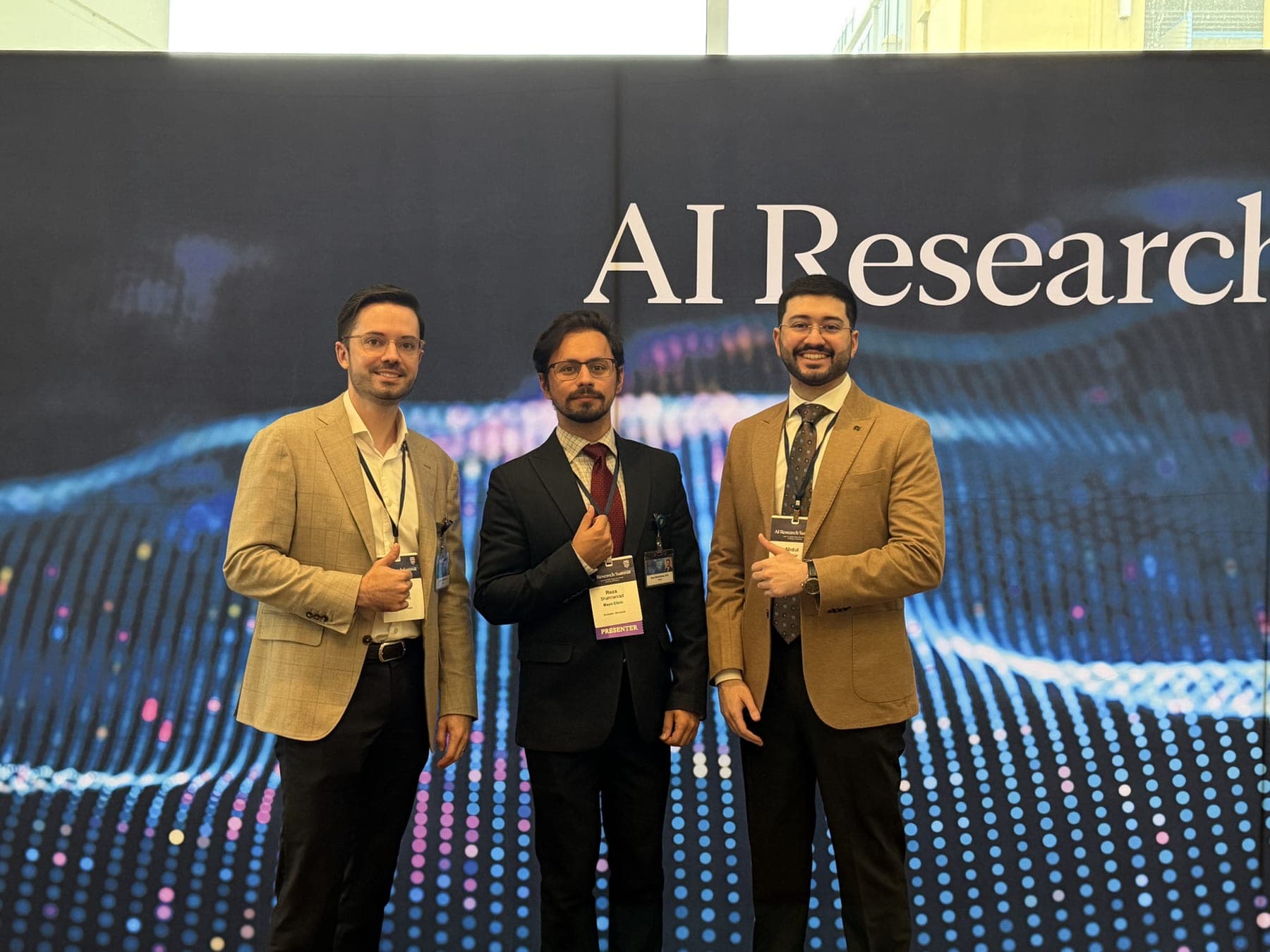
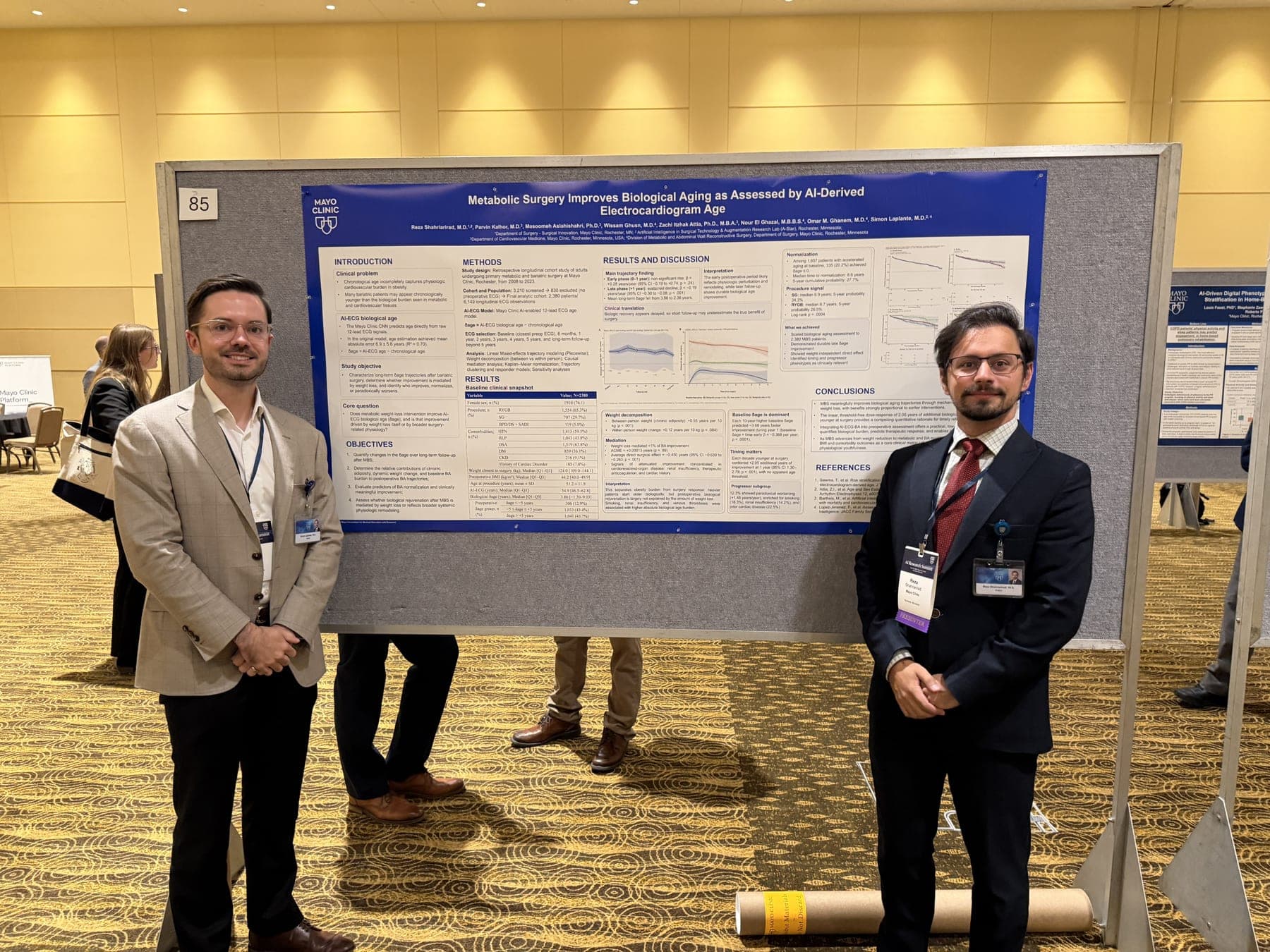
One poster evaluated improvement in biological age following bariatric surgery using AI-derived biomarkers. The presentations reflect A-STAR's broader work applying artificial intelligence to surgical outcomes, physiologic recovery, patient-centered questions, and responsible validation.

A-STAR team members attending the 2026 AI Research Summit.
A-STAR team at the 2026 AI Research Summit.
Poster presentation at the 2026 AI Research Summit.
Research posters presented during the AI Summit, including work on AI-derived biological age following bariatric surgery.

The session discussed video-language models and synthetic data in surgery.

Dr. Simon J. Laplante delivered invited education on quantum computing and intelligent surgical robotics, moderated innovation sessions, and the lab presented MOSI abstract work in bariatric surgery.

MOSI

Dr. Laplante delivered a talk on the intersection of large-scale AI and next-generation robotics toward intelligent surgical robots.

Dr. Laplante delivered a talk on quantum computing and its potential role in solving complex surgical data challenges.

Dr. Laplante served as director/moderator for a session focused on AI, robotics, quantum computing, and the digital operating room.

The lecture covered basic AI concepts and their impact on clinical care, keeping this record categorized as a talk rather than a conference attendance item.

The meeting provided opportunities to engage with minimally invasive surgery leaders, explore surgical technology, and connect with colleagues advancing AI-enabled surgical care.

His visit reflected growing collaboration between Mayo Clinic and UHN Toronto around surgical AI research, education, and performance improvement.

The poster, titled "Development of a Computer Vision Deep Learning Model to Predict Optimal Surgical Management in Abdominal Wall Reconstruction," highlighted computer vision and deep learning work for surgical decision support.

Dr. Simon J. Laplante presented on the current landscape and future directions of computer vision-assisted surgery.

GoNoGoNet

Dr. Laplante presented an introductory session on AI concepts and their impact on clinical care.

Dr. Laplante presented on the current landscape and future directions of computer vision-assisted surgery.

GoNoGoNet

Dr. Laplante served as session chair for an expert discussion on how AI may improve intraoperative surgical decision-making over the next 30 years.

Dr. Laplante presented on applications of computer vision in abdominal wall hernia surgery.

Dr. Laplante served as panel discussion moderator for a session on the future of AI in improving surgical precision and decision-making.

Dr. Laplante presented an overview of AI technologies in surgical care, covering fundamentals and the current landscape.

Dr. Simon J. Laplante appeared as a guest panelist in an ASMBS Bariatric Happy Hour webinar on the future of surgery and the use of AI for smarter, safer, and faster procedures.

Dr. Laplante delivered a separate SAGES talk in Nashville on the future of surgery and the use of AI for smarter, safer, and faster procedures. Exact session metadata should be confirmed.

Dr. Laplante discussed the use of validated GoNoGoNet to demonstrate potential clinical and educational applications of surgical computer vision in safer cholecystectomy.

GoNoGoNet